

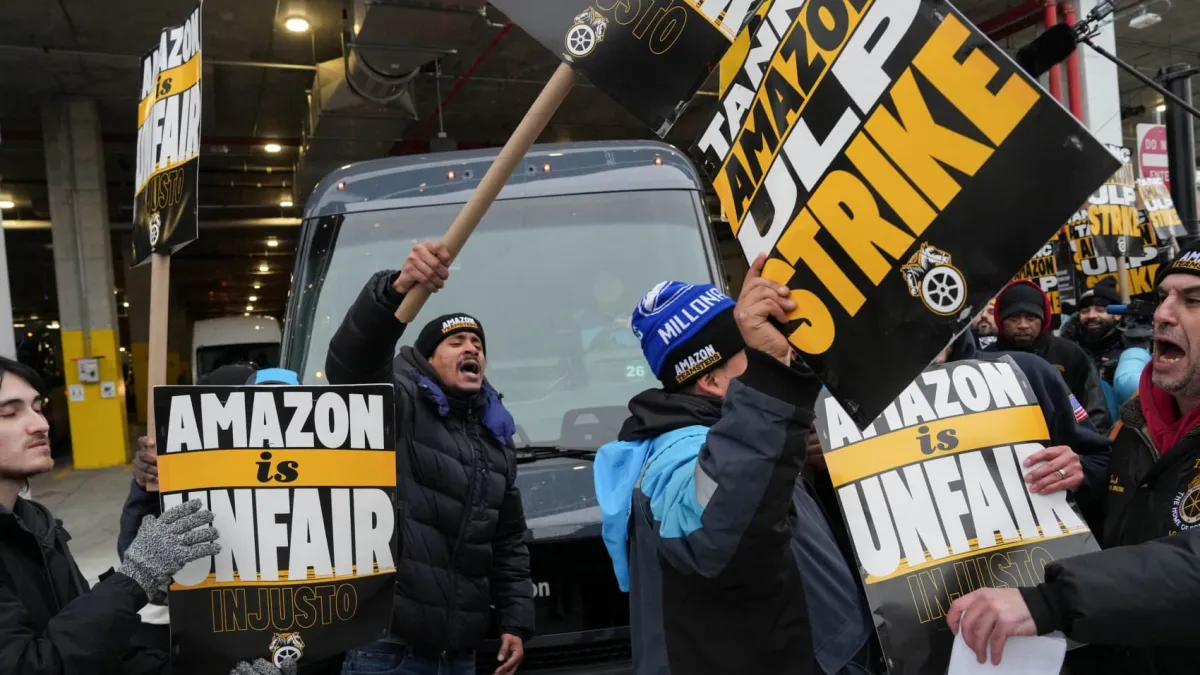
The Amazon warehouse strikes are the latest supply chain headwind facing companies this holiday season, and labor battles — which have been a prominent feature of trade disruptions this year — will contribute to “another year of disruption” for global shipping in 2025. The worker actions at Amazon organized by Teamsters union members come just weeks ahead of another possible strike by dock workers at 36 ports up and down the U.S. East and Gulf Coast.
“The year-over-year 280% increase in strike activity seen in 2023 didn’t slow down last year and we didn’t expect it to,” said Mike Short, president of global forwarding at C.H. Robinson. “We’re already helping shippers prepare for a potential U.S. port strike in January.”
Industries like automotive and pharmaceuticals that rely on a just-in-time inventory model need to be implementing and acting on contingency plans, Short said, not only in advance of a new strike but also for any further labor unrest on the horizon in 2025.
The biggest potential labor disruption could come as soon as mid-January, with a Jan. 15 deadline for U.S. ports and the International Longshoremen’s Association to reach a deal on automation at East and Gulf Coast ports. Talks between the parties recently broke down again, while President-elect Donald Trump recently voiced full support for the union position of no automation at ports.
Global shipping giant Maersk wrote in a note to clients late last week that as the Jan. 15 deadline approaches, customers should be making preparations to move containers off terminals prior to any disruptions and to avoid the issue of not being able to access cargo in the event of a terminal closure, and no extra time afforded for last-minute retrievals.
In recent years, the logistics industry has become familiar with “black swan” events, the biggest being Covid, which brought the global supply chain to a halt. The lessons learned during the pandemic led to new digital solutions for companies to track trade and solve for the lack of communication and data sharing that contributed to massive congestion at ports. Those solutions will continue to play a major role in dealing with trade disruptions.
Andrew Petrisin, Deputy Assistant Secretary for Multimodal Freight at the U.S. Department of Transportation, created the DOT’s digital platform for supply chain monitoring, Freight Logistics Optimization Works (FLOW), as a result of Covid, in March 2022. Since its inception, 86 partners including retailers, freight carriers, logistics providers, port operators, and trade associations have been sharing data to provide a more holistic view of trade, identifying trends, strengths, and weaknesses in the U.S. supply chain and infrastructure.
Today, 75% of all U.S. container imports and 80% of U.S. container terminal capacity are tracked by FLOW. Partners include MSC, the largest ocean carrier, as well as its peer companies Maersk, Hapag Lloyd, ONE, and ZIM; retailers including Home Depot, Nike, Walmart, and Target; railroads Union Pacific and BNSF; and logistics providers CH Robinson, DHL, ITS Logistics, and FedEx.
In the past few years, the platform has enabled participants to have a real-time snapshot of port and inland network congestion and monitor unexpected cargo shifts caused by disasters like the Baltimore Bridge collapse, and world events, such as the Houthi attacks in the Red Sea. Data was used by FLOW members during the Key Bridge collapse to better understand how the cargo flows were changing up and down the East Coast, where the cargo was being rerouted, and if the increase in volumes was creating congestion. The effort has also helped to monitor the supply chain for potential spikes in inflation.
“You can look at it as a kind of disruption response tool, or as a black swan event response,” said Petrisin. “We have some FLOW members who are building decision-making models to reposition inventories when they see congestion or shift their cargo when they see spikes.”